This field guide is for nontechnical founders and small teams comparing two self-hosted AI agent platforms for one supervised business job.
Choose OpenClaw when the hard part is getting work in and out of several channels, accounts, or specialist workspaces. Choose Hermes Agent when the hard part is helping a small set of persistent workers repeat a defined procedure, remember corrections, and return work on a schedule.
The test is whether a person can see, review, and use the finished result.
The Clawpany's supervised Hermes pilot made that distinction clear. A scoped request was accepted and routed, yet the person who requested the guide could see a handoff status before they could see the guide itself. The task chain did not wait for the specialist and Editor work before returning the artifact to the same Telegram topic.
This comparison asks which system can complete one defined business job with acceptable supervision, recovery, and maintenance. OpenClaw is discussed from its current official documentation. Hermes is discussed from its documentation plus that one supervised pilot. Neither has been benchmarked here for speed, cost, or reliability.
What this comparison actually measures
Both OpenClaw and Hermes can connect an AI model to tools, persistent state, scheduling, and chat channels. A feature checklist alone does not tell a founder which one will be useful next Monday morning.
This article evaluates six practical criteria:
- Job shape and routing: Is the work mainly assigning requests, or repeating a known procedure?
- Memory and reuse: Can stable preferences and a corrected procedure carry into the next run without silently drifting?
- Scheduling and delivery: Does the finished artifact reach the reviewer where they expect it?
- Permissions and approval: Can channels, writes, tools, and unattended actions be restricted to the smallest useful set?
- Failure and recovery: Does the workflow stop visibly and preserve enough context for a person to recover it?
- Ownership and maintenance: Who owns the Gateway, profiles, schedules, source material, and failures after setup?
OpenClaw is a local-first assistant control plane built around a Gateway, chat channels, agents, tools, memory, and cron work. Hermes Agent is a general agent with persistent memory, skills, scheduled work, profiles, and a messaging gateway.
Neither label means "employee." An AI employee is a workflow with a defined input, output, owner, reviewer, and recovery path.
Write the job before choosing the platform: "Every [schedule], receive [input], produce [output], and send it to [reviewer]. If [failure condition] happens, stop and report it."
That sentence is the first diagnostic. If you cannot write it, keep the work in a normal chat assistant for now.
The practical difference at a glance
| Criterion | OpenClaw | Hermes Agent | What it means for a first test |
|---|---|---|---|
| Main organising unit | Gateway, agents, bindings, channels, workspaces | Profiles, skills, memories, subagents, Bot Mode teams | Choose the unit your owner can actually maintain. |
| Strong fit | Cross-channel intake and routing | Repeatable work with stable preferences and a documented method | Do not force a routing problem into a single-worker setup, or vice versa. |
| Memory and procedures | Markdown memory, indexed recall, session history | Bounded memory, user profiles, and reusable skills | A saved note is not enough; decide who can change it and how corrections are reviewed. |
| Scheduling | Gateway cron with chat or webhook delivery | Cron with platform, local, or Bot Chat delivery | A run only counts when the reviewer receives the output. |
| Separation | Separate agents can have their own workspaces, state, and sessions | Separate profiles and subagents can carry scoped state and roles | Separation helps organisation; it is not an automatic security boundary. |
| Human control | Channel access policy, tool policy, and optional sandboxing | Command approval, write controls, isolation options, profile separation | Begin with narrow permissions and an explicit stop condition. |
The capability descriptions above come from the products' documentation. They are not a claim that the two systems behave identically in a production environment.
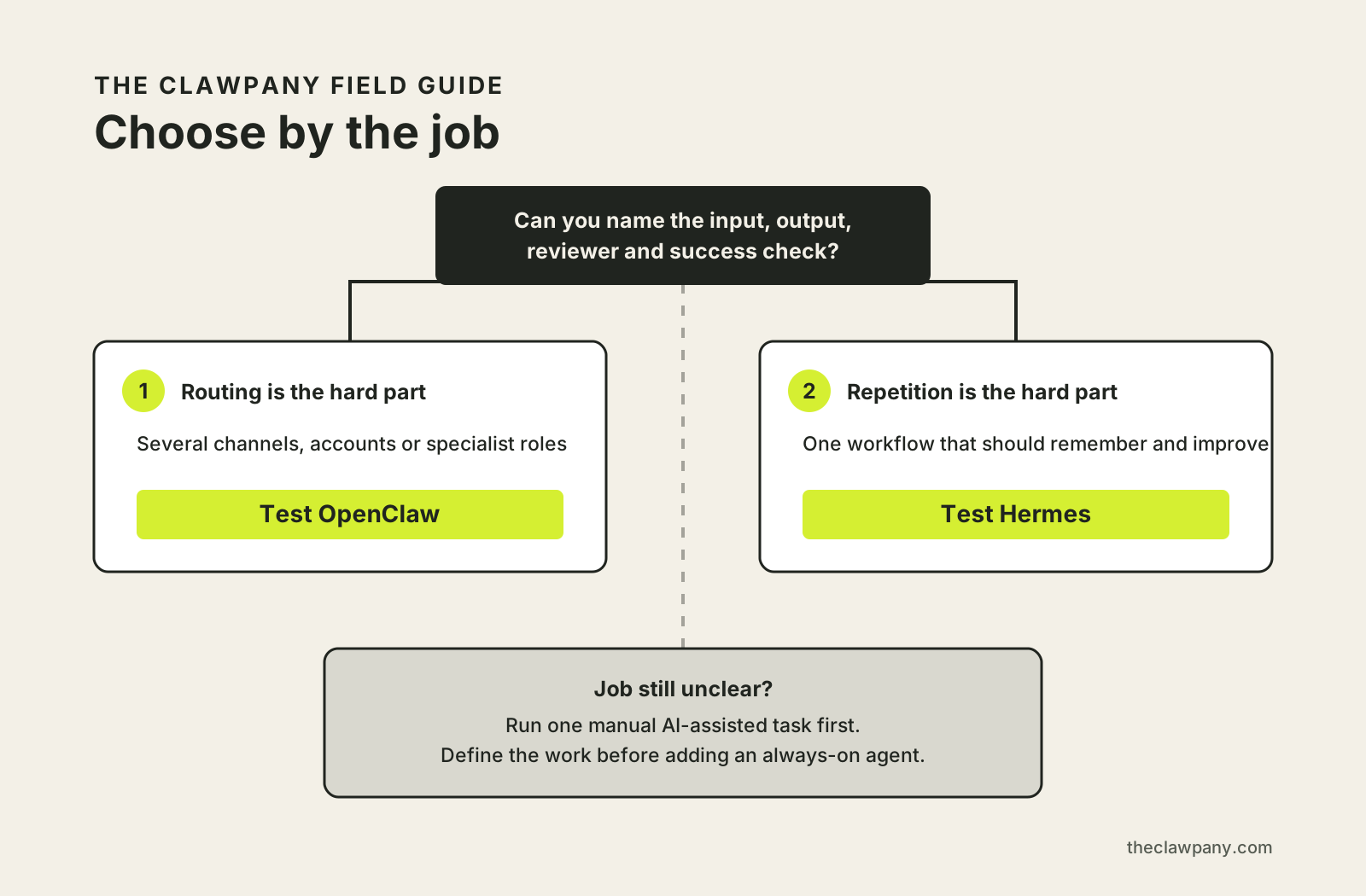
Start with the business job, not a platform demo
The following scenarios show where the choice changes. They are operating examples, not claims that either setup is already proven for every business.
Scenario 1: Requests arrive in several places
Staff and customers ask for operational help in Telegram, Slack, and email. The business wants requests classified, routed to the appropriate specialist, and returned to the correct person with an owner visible. The input is a message, sender identity, channel, and enough context to classify the request. The output is a routed task or answer with a clear owner and a status the requester can understand. The operations owner reviews a small sample of routing decisions each day.
OpenClaw is the likely starting point. Its documented multi-agent model gives agents separate workspaces, state directories, and sessions, while bindings route inbound messages to the chosen agent. Its channel configuration is designed to connect multiple messaging surfaces through a Gateway.
Here, the work is deciding which incoming request belongs where and proving that it arrived. A Gateway and explicit bindings fit that problem. Start by routing one request type, such as "website content correction," from one channel to one named reviewer. Log the original message, selected agent, output location, and reviewer decision. Do not begin with every department and every channel.
Test a message that lacks enough information or could belong to two owners. The safe result is a visible "needs triage" reply rather than an invented assignment.
Scenario 2: One internal workflow repeats every week
Every Monday, a content researcher collects approved sources, prepares a short brief, passes it to an Editor, and returns the reviewed draft to the marketing owner. The input is a topic, approved source list, house style, and deadline. The output is a source-backed brief or draft, an Editor review, and a final location the marketing owner can open. The marketing owner reviews the work, while the Editor checks source quality and usefulness before it is returned.
Hermes is the likely starting point. Hermes documents persistent memory, user profiles, and skills as reusable procedures. Its cron system can deliver a result to a named chat or another Hermes profile. That combination fits a recurring procedure that improves through explicit corrections.
A correction such as "use official sources first" should become a reviewed rule or skill instruction. The owner needs to know where the procedure is stored, who may change it, and whether the next run loaded the revision.
Run the workflow manually once before scheduling it. Require the researcher to cite sources, the Editor to return a pass/revise verdict, and the owner to receive the actual draft and review in one known location. Then make a source, Editor, or delivery chat unavailable. The workflow should stop at the failing stage and say what has not happened. A status such as "routed" does not mean "delivered."
Scenario 3: The business wants "an AI employee" but has no stable job
A founder wants help with random requests: a proposal today, customer research tomorrow, an invoice question next week. The input and output vary each time, and often nobody has been named as reviewer.
Use a normal AI assistant or a simple saved assistant while you collect five to ten repeated requests. A scheduled, tool-using agent will make the lack of a process harder to see.
Keep a small log of the request, desired outcome, source material needed, review needed, and what a good answer looks like. When one job repeats with similar inputs and a clear reviewer, promote that job into a platform pilot. Also test the broad instruction "help grow the business." It will either produce generic work or reach into systems it should not touch. That calls for a narrower scope, not more agents.
How OpenClaw would run a multi-channel job
This is a documentation-based walkthrough. The Clawpany has not run an equivalent OpenClaw pilot.
Imagine a business that wants a single intake layer for content corrections coming from Telegram and Slack. A documented OpenClaw setup would normally have these moving parts:
- A Gateway owner maintains the host, updates, channel credentials, and security reviews.
- Telegram or Slack access is restricted to approved senders or pairing rules. The business names which channel can trigger each job.
- A content-correction agent gets a separate workspace, state, and session history. It receives the minimum reference files and tools needed to inspect a page and prepare a correction.
- Incoming messages matching the approved channel and account are routed to that agent. If the request does not match, it goes to an explicit triage path.
- The agent returns a proposed correction to the requester or a named reviewer. The reviewer performs any external publish action.
- After the manual flow is useful, a Gateway cron run can send a daily summary to a chat or webhook.
OpenClaw documents multiple agents and bindings, channel configuration and access policies, persistent cron jobs, and configurable sandboxing. A workspace alone is not a security boundary, and sandboxing is off by default. Restrict absolute host paths and tool permissions deliberately.
An OpenClaw owner needs to show the route, limit it, and recover when it does not produce a visible answer.
What the supervised Hermes pilot actually showed
The Clawpany tested a narrow workflow for a first-business-AI-assistant guide. The intended path was straightforward: the business owner made a scoped request in the Product Design Telegram topic; the Coordinator created linked work; a specialist prepared the guide or visual work; an Editor reviewed it; the final files and review returned to the same topic.
The early result exposed two gaps.
First, a pre-existing Telegram conversation preserved an old prompt snapshot. After a role-instruction update, a Proceed command returned another draft instead of creating the intended task. The gateway restart had not changed the active conversation's stored prompt. The documented correction was to start a fresh topic-local session with /new, preserving the transcript but loading the current role instructions.
Second, a later run showed a reader-facing problem: the Coordinator reused an older visuals-only child brief and marked the intake done before the Product and Editor descendants had finished. The user could see a handoff or routed status without seeing the complete guide package in the same Telegram topic. Delivery required task comments and a manual outbound return.
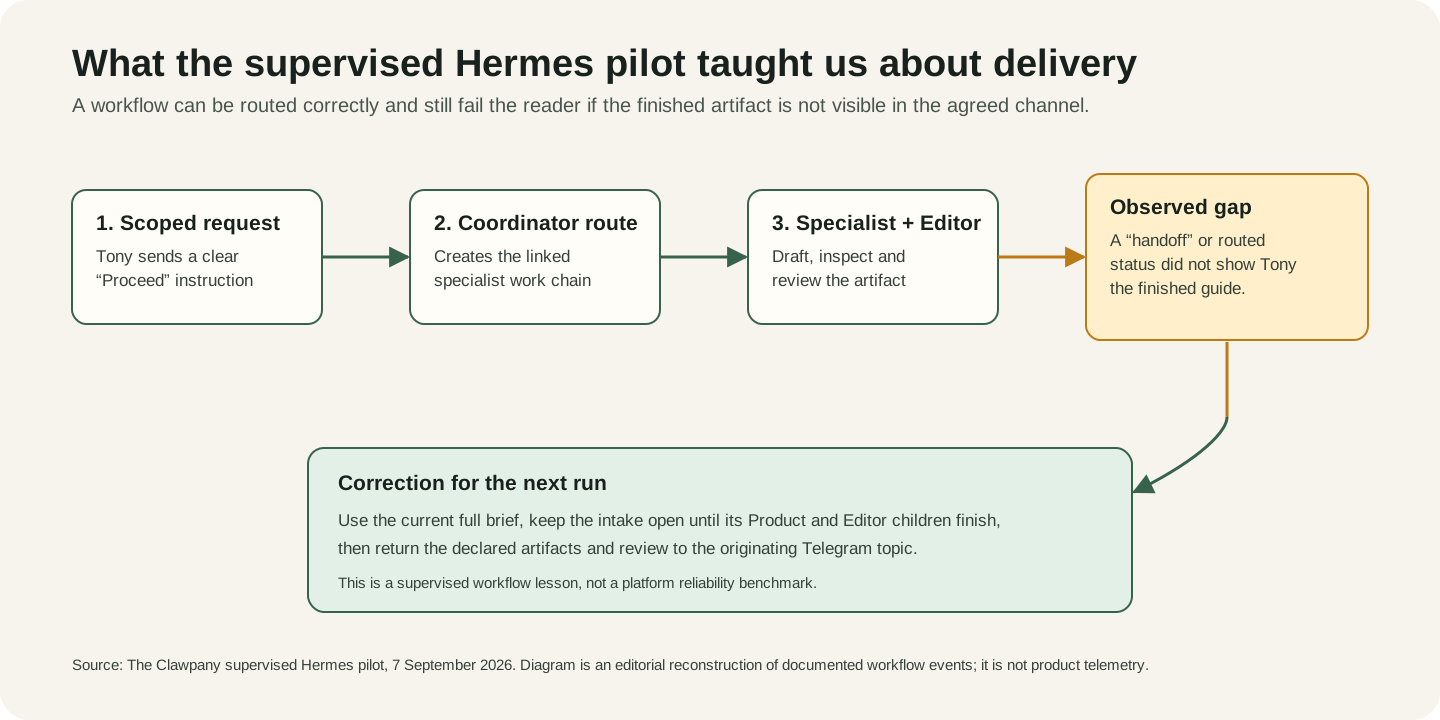
For the next run:
- Create the child task from the current full brief, not an older partial brief.
- Keep the intake open until the Product and Editor children finish.
- Return the declared artifact paths and review outcome to the originating channel.
- Treat a missing artifact, missing review, or missing delivery as incomplete work, even if an upstream task status says
handofforrouted.
This was a supervised workflow exercise, not a reliability comparison between Hermes and OpenClaw. It showed that visibility, task ownership, and final delivery must be specified as part of the job. Specialist profiles without those rules produce more conversations without completing the business process.
Compare the operating model, criterion by criterion
Compare the systems against the same operating needs and look beyond their feature lists.
1. Routing and separation
OpenClaw's documented model exposes routing more directly when incoming work needs to be assigned across channels, accounts, or agents. Bindings and separate workspaces make the routing map explicit. That helps an owner answer "which agent received this?" and "where did its state live?" This is an architecture-based inference, not a result from comparative testing by The Clawpany.
Hermes profiles separate roles, memory, skills, and credentials. This is useful when the team has a stable researcher, editor, coordinator, or product role that repeats. The pilot shows that role separation alone is insufficient: the Coordinator still needs the current brief, parent-child completion rules, and a final return path.
Choose OpenClaw if intake and routing are the main source of complexity. Choose Hermes if the role and repeated procedure are the main source of complexity. In either case, document the owner for every handoff.
2. Memory and reusable procedures
OpenClaw documents Markdown memory, indexed recall, and session history. That can preserve useful project facts across work, but the owner still decides what is stable enough to save and what should remain temporary context.
Hermes distinguishes shorter persistent memories and longer reusable skills. The strength is procedural reuse: a corrected weekly research process can be captured as a skill and loaded when the job recurs. The risk is silent process drift if anyone can change memory or skills without review.
If you need the worker to perform the same sequence again, write the sequence before turning it into a skill. Give one owner authority to accept changes. Test that the revised instruction loaded on the next run.
3. Scheduling and delivery
Both products document scheduled work. OpenClaw cron can deliver to chats or webhooks, while Hermes cron can deliver to platform, local, or Bot Chat destinations. That is the capability layer.
The operating layer is more demanding: the run must produce the expected artifact, the reviewer must receive it, and the system must show what happened if delivery fails. The Hermes pilot is a concrete reminder that a task can be created and routed without completing the reviewer's job.
Count a scheduled run as successful only when the reviewer confirms the artifact arrived in the agreed place. Track execution and delivery as separate fields.
4. Permissions and human approval
OpenClaw advises restricting channel access, using tool policies, and considering sandboxing. Its security guidance also warns against treating a shared Gateway as tenant isolation. Hermes documents user authorization, command approval, file-write controls, optional container isolation, and cross-session separation in its security guide.
Neither platform turns a broad permission into a safe one. A first pilot should read approved sources, create drafts, and send an internal report. It should not publish, contact customers, change financial records, or execute destructive commands without an explicit human gate.
Start with the smallest useful permissions. If the agent cannot create a useful output under those limits, simplify the job before expanding access.
5. Failure reporting and recovery
An agent workflow needs an answer for missing input, conflicting instructions, a failed tool call, an unavailable reviewer, and a failed delivery. "Try again" is not a recovery plan.
For a routed OpenClaw job, the recovery action might be a triage queue that shows the original message and the reason routing stopped. For a Hermes repeat-work job, it might be a blocked status that preserves the source list, partial draft, and exact missing approval for the owner.
Write the stop condition in the job sentence. Then simulate one failure before scheduling the work. A useful failure report names the stage, cause, preserved artifact, owner, and next manual action.
6. Maintenance responsibility
The platform is only part of the operating cost. Someone must maintain model access, credentials, source freshness, scheduled jobs, staff access, skills, prompt changes, and recoveries.
OpenClaw calls for a Gateway owner. Hermes calls for profile and workflow owners. The labels differ, but the business responsibility is the same. If the owner is "the AI," there is no owner.
Name one human owner before enabling a recurring job. That owner receives failures, approves process changes, and decides whether the test continues.
Run a seven-day test that produces a real decision
Do not give either platform broad business access on day one. Use a fictional, internal, or low-sensitivity workflow until the process is useful and predictable.
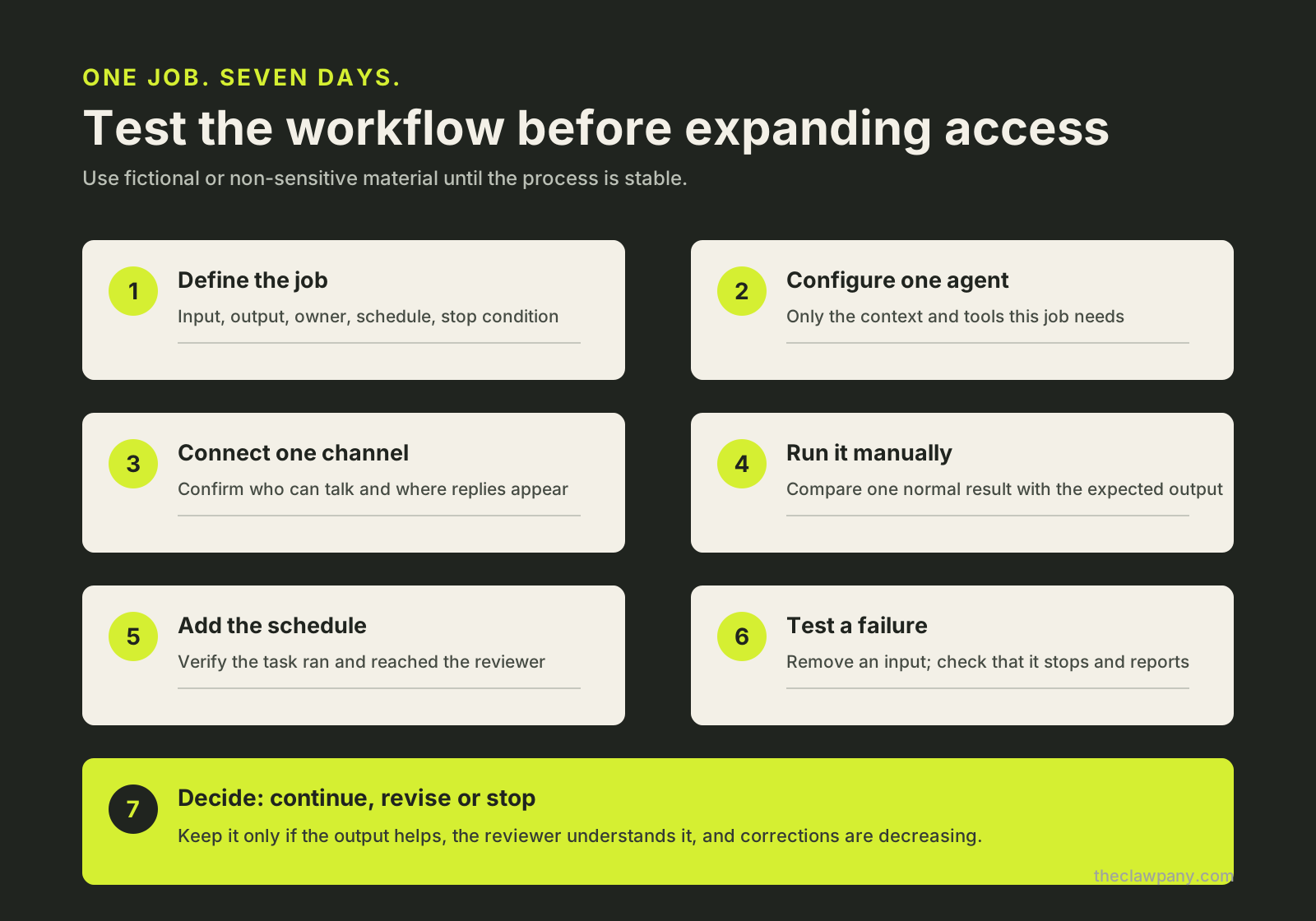
The daily sequence
| Day | Do this | Evidence to save | Stop if… |
|---|---|---|---|
| 1 | Write the job sentence, owner, reviewer, output, and failure condition. | One-page brief. | Nobody can agree on a useful output. |
| 2 | Configure one agent or profile with only the required source material and tools. | Configuration summary and permissions list. | The job needs broad credentials to work. |
| 3 | Connect one approved delivery channel. | A received test message. | You cannot identify who can trigger it or where replies go. |
| 4 | Run one normal request manually. | Input, output, reviewer comments, correction list. | The reviewer cannot assess the output without doing the job themselves. |
| 5 | Schedule one run only after the manual result is useful. | Execution time, artifact path, delivery proof. | It runs but the reviewer does not receive the result. |
| 6 | Test one realistic failure. | Failure report, preserved partial work, recovery decision. | It continues with invented assumptions or hides the failure. |
| 7 | Score the result and decide. | Completed scorecard and owner decision. | The work creates more checking than it removes. |
Copy this scorecard into the task
Score each criterion from 0 to 2 after the seventh day. Attach the evidence beside the score.
| Criterion | 0 | 1 | 2 | Score | Evidence / repair |
|---|---|---|---|---|---|
| Output usefulness | Not usable | Usable after substantial rewrite | Useful with minor edits | ||
| Reviewer visibility | Artifact or status is missing | Visible, but progress is unclear | Artifact, review, and next step are visible | ||
| Delivery | Did not reach the reviewer | Reached after manual chasing | Reached the agreed place automatically | ||
| Corrections | Same major error repeated | Corrections decrease but procedure is unclear | Corrections are captured and reused deliberately | ||
| Failure recovery | Failure was hidden or invented around | Failure reported but recovery was manual and unclear | Failure names owner, cause, preserved work, and next step | ||
| Permission fit | Needs unsafe or broad access | Has more access than necessary | Uses only the minimum needed access | ||
| Owner confidence | No one wants to own the next run | Owner accepts a revised test | Named owner will run the next controlled cycle |
Decision thresholds:
- Continue: 11 to 14 points, no zero in delivery, failure recovery, or permission fit, and the named owner agrees to one more controlled cycle.
- Revise: 7 to 10 points, or one zero in a non-destructive area. Fix the lowest-scoring stage, then repeat only the affected days.
- Stop: 0 to 6 points, any unsafe permission requirement, a hidden failure, or no one willing to own recovery. Return to a manual assistant and define the job better.
The score is not a scientific product benchmark. It is a small business decision aid that keeps enthusiasm from replacing evidence.
Minimum security rules for the first pilot
For either platform, the first test should be deliberately boring: internal material, narrow tools, a named reviewer, and no irreversible action.
For OpenClaw, use approved channel access, restrict which agent receives which messages, enable an appropriate sandbox or isolation approach, and review tool access. Run openclaw security audit after material configuration changes. The security documentation describes the audit and isolation considerations; the sandbox documentation describes its scope and limitations.
For Hermes, keep dangerous command approval in a reviewed mode, keep unattended tasks from gaining wider command access by default, use write approval for agent-created memory or skills when appropriate, and consider container isolation for command-running production work. Check the current Hermes security documentation before configuration, because defaults and options can change.
For both, keep customer messages, money movement, production deployments, and destructive changes behind human approval. A platform's ability to perform an action is not approval to perform it.
Recommendation: choose the smaller useful operating model
Start with OpenClaw if your first job is multi-channel intake and routing. You need a Gateway owner, one narrow binding, one delivery location, and a visible triage path for uncertain messages. This recommendation would change if your work turns out to be one repeated internal procedure rather than a routing problem.
Start with Hermes if your first job is a recurring internal workflow that improves through documented preferences, skills, and a named review chain. The Clawpany pilot showed that this can be a useful supervised pattern, while also showing that Coordinator completion and artifact delivery need explicit rules. This recommendation would change if your team mainly needs a broad channel front door rather than a persistent procedure.
Start with a manual AI-assisted workflow if the input, output, reviewer, and failure condition still change every time. Use it to find the job that deserves automation.
Pick one job and make the result visible
Copy this sentence and fill in the five blanks:
Write the first job
Fill in the five parts with a low-sensitivity, supervised first task. Your inputs stay in this browser and are not sent or saved.
Your job sentence
Copy uses your browser clipboard when available. If it is unavailable, a manual-copy dialog opens with the same sentence.
That is Day 1. Complete Days 2 to 4 with the person who will own the technical setup. Do not schedule the workflow until the reviewer can open a useful output, see the correction history, and understand the recovery step.
Plan your first AI workflow before you add another agent, channel, or schedule.